
In this article
Part I: From Stabilisation to Inclusive Growth
Macroeconomic stabilisation has created an opportunity for recovery. But Nigeria's next challenge is to deliver growth quickly and broadly enough to strengthen economic resilience, sustain public confidence and withstand the political tests of 2027 and 2031.
Nigeria's next economic challenge may be as much political as it is economic. Can the political capital required to maintain the governing coalition also be mobilised to transform the economy?
The question deserves attention as Nigeria approaches the 2027 general election. For businesses, investors and institutions, the stakes extend beyond the electoral outcome to the political and economic assumptions underpinning their plans through 2031.
The Tinubu administration has undertaken difficult reforms to correct longstanding macroeconomic distortions. Hard-won progress has been made towards stabilising the foreign-exchange market, rebuilding reserves and improving investor confidence. Yet the benefits have not translated quickly or broadly enough into improvements in individual incomes and household welfare.
October's headline inflation rate of 14.06% offers encouragement, but food inflation remained at 19.13%. Slower inflation does not reverse years of rising prices, and household purchasing power remains under considerable pressure.
Markets may reward reform. Voters may punish pain.
During my time working with Nigeria's economic management team, we communicated an economic programme built around stabilisation, resilience and growth.
But stabilisation was never the destination. It was meant to create the conditions for recovery, investment and rapid, sustained growth. In our assessment, what may have been underestimated, including within government, was the time, political capital, institutional coordination and investment prioritisation required to translate macroeconomic progress into tangible benefits for businesses and households.
More recently, government's economic messaging has exposed a tension between international credibility and domestic confidence. Record revenue collections, publicly emphasised and likely to reassure investors, multilateral institutions and ratings agencies, have nevertheless contrasted with weak budget implementation and continued economic hardship. As tax reforms take effect, this risks reinforcing perceptions that government is more effective at collecting revenue than delivering benefits. Sustaining public confidence requires demonstrating how fiscal gains translate into productive investment, better services and improved livelihoods.
The missing link between stabilisation and growth
The government recognises the challenge. In his recent address at Chatham House, Finance Minister and Coordinating Minister of the Economy Taiwo Oyedele described a transition from public borrowing to private investment, from consumption to production, and from foreign-currency borrowing to mobilising domestic capital. He also acknowledged that macroeconomic stability means little to households still struggling to afford food.
Oyedele’s priorities echo those articulated by his predecessor, Wale Edun. The challenge is not a lack of ambition or initiatives, but translating these priorities into a coherent programme addressing the interconnected constraints on productive growth.
Financing, energy, agriculture, industry, infrastructure and human capital development must reinforce one another. Nigeria has a Coordinating Minister of the Economy, but bringing powerful ministries and agencies behind shared priorities requires clear mandates, political authority and accountability for results.
It also requires better use of economic data.
Nigeria's National Bureau of Statistics produces important official statistics using established methodologies. Yet statistically valid indicators do not always capture the economic conditions policymakers most urgently need to understand. A low headline unemployment rate, for example, can coexist with widespread working poverty, insecure livelihoods and inadequate incomes.
The Coordinating Minister of the Economy should help establish a common evidence base for decisions across government, including measures of progress that Nigerians can recognise and trust. Achieving this will require institutional cooperation and the political authority to align sometimes competing priorities.
Growth must reach businesses and households
Nigeria's recently published Projects Nigeria investment pipeline illustrates both the opportunity and the challenge.
The portfolio seeks $80.4 billion for 69 projects, with an estimated 366,763 jobs. That sounds modest relative to the scale of investment. Energy and transport dominate the published sector breakdown. The important questions are how projects have been prioritised, which constraints they address, how they connect and when their benefits will reach businesses and households.
A pipeline is not secured capital.
Government-reported pipeline estimates, not evidence of funds secured or jobs created.
- 69
- Projects in pipeline
- US$80.4bn
- Capital requirement
- 366,763
- Estimated jobs
These investments could address important constraints on productivity and competitiveness. But an investment pipeline is not secured capital. Projects must secure financing, be developed and constructed, become operational and generate wider economic activity. Their full economic benefits may take years to emerge, potentially beyond 2031.
Agriculture illustrates the urgency.
Food prices directly affect household welfare, yet agricultural transformation requires action on insecurity, irrigation, energy, storage, logistics, processing, finance and market access.
Delivery at scale must address practical value-chain gaps such as inadequate cold-chain infrastructure, which contributes to food losses, safety risks and higher costs.
The challenge is equally acute for small and medium-sized enterprises.
Government-backed credit guarantees and enterprise-support programmes may improve financing opportunities. Many Nigerian businesses face a double squeeze: rising costs of doing business and falling purchasing power among their customers. Cheaper credit may help, but it cannot resolve either problem on its own.
Nigeria must address the missing middle of productive businesses capable of scaling, innovating, improving productivity and creating the quality and volume of jobs needed to rebuild the middle class.
Affordable, appropriately structured finance, supportive tax policies, business confidence and lower structural costs are essential to unlocking productive investment and rapid, broad-based growth. Stronger employment, rising real incomes and improved household purchasing power must follow from that transformation, reinforcing domestic demand and economic resilience.
And speed matters profoundly.
Nigeria cannot wait for its largest infrastructure investments to mature before businesses and households begin to experience the benefits of reform. Inclusive growth is not the eventual reward for successful stabilisation. It is essential to sustaining it.
With little time for structural reforms to deliver meaningful improvements in household welfare before the election, political pressure may increasingly favour short-term concessions. The administration's October petrol discount, announced weeks after Atiku Abubakar promised to restore fuel subsidies and amid an increasingly public contest over petrol affordability, illustrates how opposition pressure can influence the government's political response without necessarily reversing its economic reforms.
At a time of geopolitical upheaval, energy-market uncertainty, changing trade relationships and volatile financing conditions, Nigeria needs stronger domestic productive capacity, greater food security and broader sources of income growth.
Inclusive growth is therefore more than a development objective. It is an economic resilience and national stability imperative. Though the election arrives before the economic benefits of stabilisation are widely felt, the political consequences of that delay will likely extend well beyond it.
Part II: The Politics of Economic Delivery
The political cost of coordination
Economic transformation demands difficult choices about resources, institutional responsibilities and policy priorities.
In Nigeria, those choices must be made within a political system shaped by regional interests, governors, political financiers and competing centres of influence.
The APC's institutional dominance should not be mistaken for unconditional political cohesion. Maintaining its governing coalition requires continuous negotiation and accommodation, sometimes involving appointments, expenditure priorities and the allocation of public resources.
But political accommodation is not inherently incompatible with effective government. Coalitions can provide the support needed to implement difficult reforms. That said, maintaining them can also compete with the discipline required for economic transformation.
The tension is visible in the administration's institutional choices.
In February 2024, the Federal Executive Council approved implementation of the Oronsaye recommendations to reduce agency duplication and the cost of governance. Yet the administration subsequently established additional regional development commissions, including those for the North-West and South-West, with their own governing structures, staffing and development mandates.
Regional development is a legitimate objective. Institutions operating across state boundaries could help address longstanding development gaps. But expanding the federal institutional landscape while pursuing administrative rationalisation raises questions about efficiency, overlapping responsibilities and competing priorities. The test is whether the development benefits justify the additional structures and costs.
The challenge extends beyond federal institutions.
In his Chatham House address, Oyedele argued that while macroeconomic stability is principally a federal responsibility, shared prosperity depends heavily on delivery at the subnational level. He proposed using federal transfers and incentives to encourage state governments to prioritise productive investments.
This matters because agricultural productivity, rural infrastructure, education, healthcare and local business conditions cannot be transformed through federal policy alone.
Tinubu's coalition-building strengths should therefore be an asset to economic delivery, not merely a competing demand on political attention.
But political cooperation does not automatically translate into effective implementation. Securing agreement on appointments, alliances or expenditure priorities is not the same as securing agreement on which economic constraints should be addressed first, by whom and with what resources.
Part III: The Political Tests of 2027 and 2031
The electoral test of 2027
2027 will test whether the governing coalition can retain power. The APC has considerable institutional reach, but political dominance is not the same as popular consent, particularly amid prolonged economic hardship.
The opposition remains divided, although fragmentation need not prevent convergence around shared economic and security grievances. Changes in public sentiment, political alliances or voter mobilisation could alter the electoral environment.
Turnout in Nigeria's 2023 presidential election was approximately 27% of registered voters, the lowest since the return to democracy in 1999. The reasons were varied, but the figure raises an important question: could dissatisfaction produce greater political mobilisation in 2027?
Oyedele has publicly expressed confidence that reform discipline will survive 2027, citing institutional safeguards, budget reforms and greater transparency.
Those commitments matter. But the durability of individual stabilisation reforms should not be confused with the durability of the wider economic transformation programme.
Even if the exchange-rate regime and petrol-pricing reforms endure, governments must continue making difficult decisions about expenditure, taxation, institutional responsibilities and the distribution of resources. Those choices remain exposed to political negotiation, particularly when improvements in household welfare have yet to match expectations.
The longer shadow of 2031
A Tinubu victory in 2027 would offer near-term policy continuity. But continuity throughout the following four years is less certain.
As an incumbent's tenure approaches its end, promises of future appointments, political and economic opportunities may carry less weight. Potential successors cultivate independent alliances, regional power brokers reassess their interests, and political financiers begin looking towards the next centre of power.
The cost of maintaining cohesion may rise even while the governing coalition remains publicly intact.
The coalition that defeated the PDP in 2015 brought together two distinct but complementary forms of political capital.
Muhammadu Buhari commanded an unusually loyal grassroots following, particularly across Northern Nigeria. His electoral appeal rested substantially on personal credibility and identification with a political constituency that had supported him through successive unsuccessful presidential campaigns. That loyalty was not entirely dependent on access to government, appointments or immediate political rewards.
Tinubu brought something different: organisational capacity, a formidable political network rooted in the Southwest, and the ability to negotiate alliances across regional, institutional and political interests. His contribution was instrumental in assembling and sustaining the coalition that eventually displaced the PDP.
Buhari's passing removed a distinctive source of electoral loyalty and political cohesion within the APC. President Tinubu remains its central organising force, but the party's longer-term stability raises an important question: how much of its cohesion has become institutionalised, and how much still depends on his personal authority and capacity to reconcile competing interests?
The PDP's experience before 2015 reminds us that institutional dominance does not guarantee enduring cohesion. A broader political realignment ahead of 2031 is possible, though far from inevitable.
And the economic implications are considerable.
Nigeria's major infrastructure and industrial investments require sustained coordination and financing, potentially beyond 2031. Yet the political consensus supporting them may be tested much sooner, first by the 2027 election and then by succession politics.
Economic transformation and political cohesion are therefore not simply competing objectives. Each can reinforce, or undermine, the other.
Two horizons.
One delivery challenge.
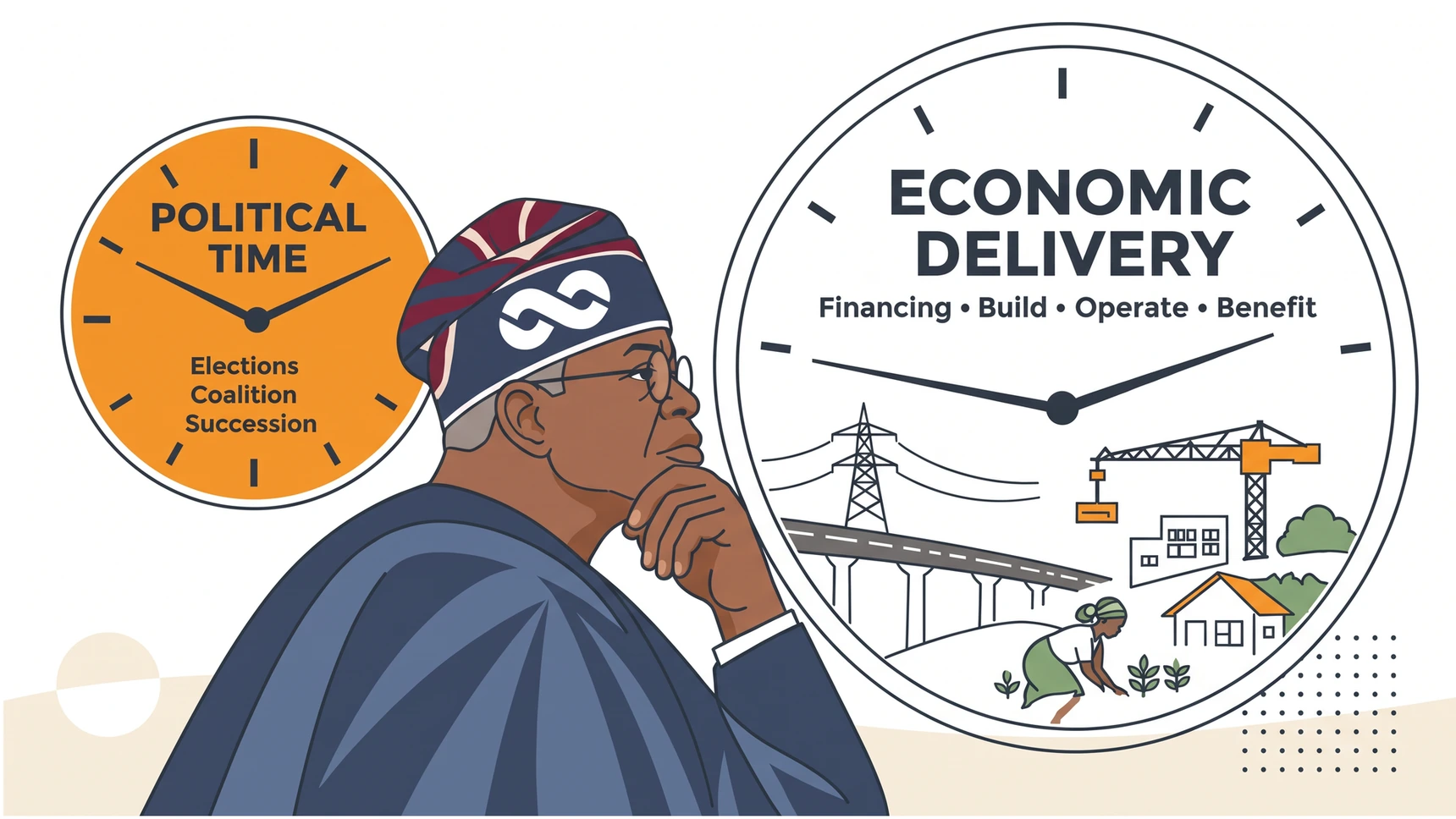
Political cycles are short. Economic delivery takes longer.
Political time
Economic delivery time
- 01Financing
- 02Development
- 03Construction
- 04Operations
- 05Wider economic benefits
Some investments and their wider benefits may take longer
Political time
Economic delivery time
2031 ↓Sequence continues
Some investments and their wider benefits may take longer
Implications for Businesses and Institutions
For businesses, investors and institutions, political continuity may preserve the broad direction of reform without guaranteeing continuity in implementation, incentives or expenditure priorities. Decisions about capital allocation, market expansion, infrastructure development and long-term partnerships must therefore account for the institutional and political conditions required to deliver them.
The more revealing indicators will be whether productive investment quickly translates into improved livelihoods, whether federal and state governments can align their priorities, and whether public resources and institutional responsibilities support measurable economic outcomes.
Changes in coalition relationships and succession dynamics will also matter, particularly where they affect policy discipline, implementation or the allocation of public resources.
Nigeria's defining test through 2031 is whether the political capital that sustains power can also deliver the inclusive growth on which economic resilience and political stability depend.